Speculations
Marylebone Theatre
We cannot re-write history. That’s a fact. It’s already there written down for all to see. But what we can do, and what writer Torben Betts does in this play, is to speculate about circumstances and conversations that might or might not have taken place before the unexplained deaths of Marilyn Monroe, John F. Kennedy and Lee Harvey Oswald. Three deaths that shook America. But one woman refused to stop asking questions.
The play is primarily set in New York, 1965. Celebrated journalist and television star Dorothy Kilgallen is on the trail of the biggest story of her career. Three years earlier, Marilyn Monroe was found dead in Los Angeles. A year after that President Kennedy was assassinated in Dallas. Then his suspected killer, Lee Harvey Oswald, was himself shot dead — live on television. America’s questions were answered but Dorothy was not convinced.
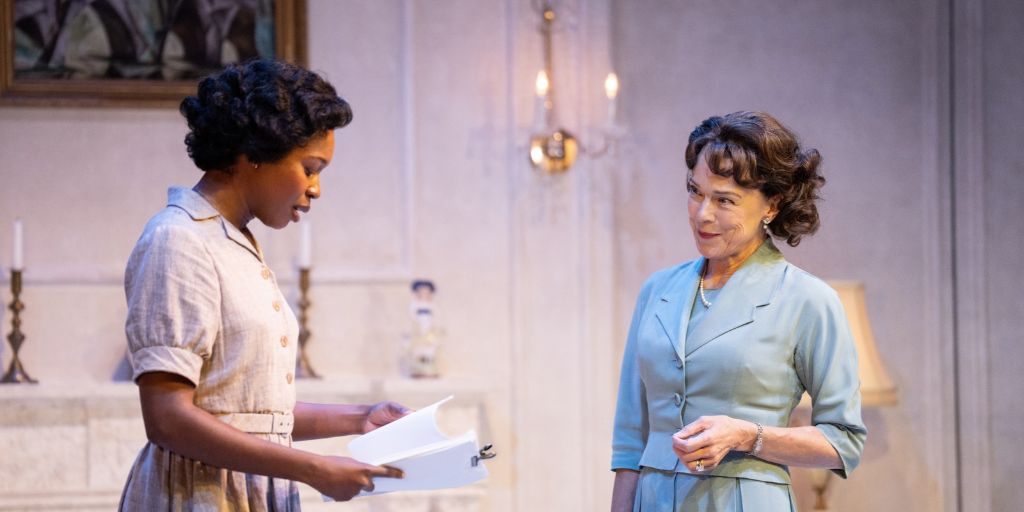
As the play opens, she is days away from handing in the manuscript of her latest investigative book to her publisher. Her previous book on the death of Marilyn Monroe never saw the light of day. She is working to a tight schedule so employs a babysitter to come and attend to her son whilst she completes her draft. The babysitter, Flo, is a black American with an interest in civil rights and also hankers to be a journalist herself. As they get to know each other Dorothy tells Flo about the book she is writing and the fact that she knows that there are people out there who will not want the book to see the light of day for what it may reveal or just even speculate on. Did Lee Harvey Oswald really fire the bullet that killed JFK? If so, why did he fall back in his car in the way he did? Dorothy clearly thinks Oswald has been used as a scapegoat, but why was he on the top of the book depository building with a rifle in the first place? Was he just there as a patsy to take the rap and if so, why did he agree to be there at all? And how did Jack Ruby get such easy access to Oswald at Dallas Police Headquarters to be able to assassinate him on live tv?
We are taken to an imagined conversation between Oswald and New Orleans “Godfather” Carlos Marcello as they discuss Oswald’s political viewpoint and Kilgallen points out that Marcello has many points he wants to settle with the Kennedy brothers. Did Marcello coerce Oswald into being in the right place at the wrong time on the fateful day in Dallas back in 1963?
Dorothy also tells Flo about her previously unpublished book about the death of Marilyn Monroe which the world has been lead to believe was a case of suicide but Kilgallen has other ideas and informs the child sitter that she knows for a fact that Bobby Kennedy visited Monroe twice on the day she died. From there she speculates on what might or might not have been said between the two of them and what the ultimate outcome may have been.
As Dorothy gets nearer and nearer to handing in her manuscript she cannot help but feel that someone is out to get her – they will stop at nothing to prevent her from revealing what her investigations into these deaths has lead her to believe.
The cast is lead by Janie Dee as Dorothy Kilgallen. For most of the play she is merely the narrator explaining and discussing her theories with child minder Flo (Gloria Obianyo). This gives Dee little scope to show what a versatile actress she is. The rest of the cast ably support. Jolyon Coy at Robert Kennedy is suitably on edge and desperate as he tries to persuade Monroe to hand over the diary she has kept which might reveal some seriously embarrassing bits of pillow talk that both he and his brother JFK might have had with her. Natalie Dunne’s Monroe looks like the Hollywood bombshell we remember but shows that in reality she was nothing like the ditzy blonde she was always made out to be – “that Marilyn Monroe is a creation”. Joseph Potter plays the intense and confused Lee Harvey Oswald and Ferdy Roberts is the slimy, greasy Carlos Marcello who you definitely wouldn’t want to cross or meet in a dark alley late at night.
Lee Newby’s sumptuous set works well as it easily transforms itself from being Dorothy’s sitting room, to Monroe’s bedroom and to Marcello’s nightclub bar.
Directed by Trevor Nunn, the trouble with the play is that is lacks any sort of pace. It is just one speculative conversation after another. There is nothing new to reveal here – we’ve heard and seen it all before – and, of course, nothing can be proved one way or the other. People with dark secrets to hide make sure they cover their tracks when performing deadly deeds.
So we are left with a play that asks many questions and audiences will leave the theatre searching for answers. Whether they are the correct answers or note we can only speculate.
⭐⭐⭐
Reviewer: Mike Linane