Revolver
Soho Theatre
Until 5th December 2026
Inspired by the Beatles’ landmark 1966 album, Revolver, written and performed by Emily Woof and directed by Hamish McColl, attempts to connect personal memory with political upheaval, popular culture and female anger. It is a production rich in ideas and visual imagination, although its dramatic execution is considerably less convincing.
Following the breakdown of a marriage, the sorting of personal belongings becomes a mechanism for revisiting the past. Objects retrieved from numerous boxes trigger memories, allowing different periods and experiences to unfold within the confines of a single room.
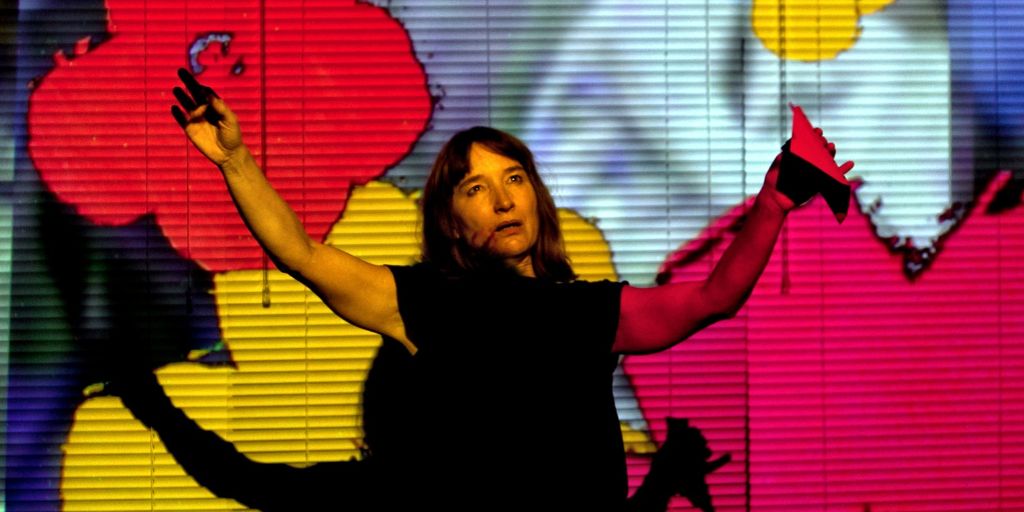
The visual storytelling is particularly effective. The window blinds serve both as a surface for projected historical imagery and, through changes in stage lighting, as a means of returning us to the present. The video design thoughtfully juxtaposes political turmoil with popular music, suggesting how the sounds of suffering can become submerged beneath the entertainment of an era. The wealth of props also gives the recollections a tangible quality.
However, the individual narrative episodes are not always organically connected. Musical transitions frequently separate one story from another rather than developing a continuous dramatic journey. We hear a great deal about the protagonist’s life, yet rarely feel that we have been allowed to enter it.
Woof’s performance is further undermined by problematic amplification. Much of her delivery is breathy and almost whispered, while the amplified voice has a noticeably harsh, distorted quality. A live telephone effect is a thoughtful detail, but its impact is diminished by the similarly coloured vocal sound elsewhere. Greater vocal projection and a more natural amplified sound would have made the performance considerably more comfortable to listen to.
As the production progresses, its exploration of female anger becomes increasingly explicit. Yet anger alone cannot substitute for dramatic development. The emotional intensity grows without an equally convincing development of the arguments or relationships behind it. Consequently, the climactic action feels insufficiently prepared, both psychologically and narratively.
The audience responded warmly, with frequent laughter, suggesting that the production’s cultural references and humour resonate strongly with some spectators. However, that connection may prove less immediate for audiences without the same cultural familiarity.
Towards its conclusion,
Revolver invites the audience to decide what the story ultimately means. Ambiguity can be a powerful theatrical device, but here it feels more like a consequence of the production’s determination to address too many subjects without fully developing them.
There is much to admire in the thoughtful visual design and the ambition of Woof’s writing. Ultimately, however,
Revolver is more successful at presenting fragments of a life than at bringing that life into focus.
runs at Soho Theatre until 5 December 2026.
⭐⭐⭐
Reviewer: Sammi Xing
Photo: Sheila Burnett