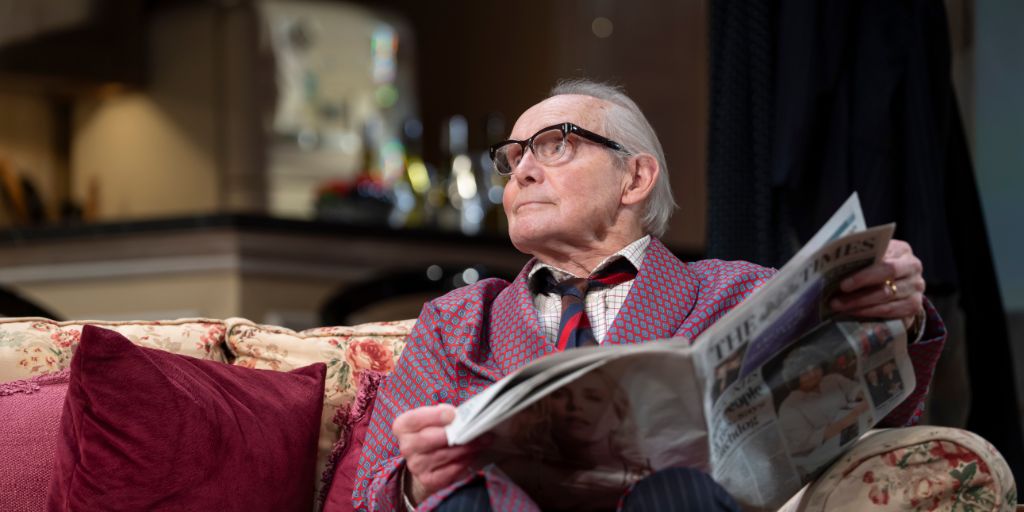
I’m Sorry Prime Minister
Theatre Royal Brighton
Written by Jonathan Lynn
Directed by Jonathan Lynn and Michael Gyngell
This is the second production for the stage as sequels to the enduringly popular TV series, ‘Yes Minister’ and ‘Yes, Prime Minister’ of the 1980s. Featuring Paul Eddington as Jim Hacker and his trusted senior civil servant Sir Humphrey Appleby played by Nigel Hawthorne, both much loved, now sadly no longer with us.
At this point I will admit to not ever watching a whole programme back in the day, however it was impossible not to be aware of the storyline and its characters, and I frequently saw and heard snippets from some of the series during its run on TV. Fortunately, for this stage show, only a vague familiarity with the material is required and it is fairly simple to recall those well known characters and visualise them literally ‘in their prime’. This latest adaptation, for its Brighton run at least, stars Robert Kitson as Hacker and Clive Francis as Sir Humphrey. The well know main character traits of Jim Hacker and Sir Humphrey were, for the first a sort of bumbling bewilderment, and a superior verbosity from the second, famous for his endless ‘word salads’.
Bringing us up-to-date with those familiar iconic characters has meant transforming them by Jonathan Lynn into a couple of old has-beens living out their days in a haze of nostalgia and a misplaced feeling of permanent importance, topped by a sense of unfairness in their present lot. Hacker is now a Peer in the House of Lords, a Master of the Oxford College bearing his name as a benefactor, and Humphrey is suffering with having to live with his ‘Evil Queen’ of a daughter-in-law, plus an avaricious family. They reunite after years apart simply because each needs a favour from the other.
This script is both clever and rapier sharp shot with a good number deliciously piercing one-liners from Sir Humphrey, and peppered with jokes and crumbs of nostalgic reminiscence which audiences will love. I couldn’t pretend to identify with most of those latter aspects, however I did enormously appreciate the timing, the pace and the sheer energy of these two actors delivering faultlessly jaw-dropping dialogue without a sliver of hesitation, never a stumble, never a slip.
The action focuses on the reunion of the old friends and political sparring partners, Hacker now forced to employ a carer (Correction, careWORKER) to help with his ‘minor’ age-related indispositions. His new employee Sophie is played by the wonderful Princess Donnough who proves to be a perfect link from the past to the present, a tool which Jonathan Lynn thankfully recognised as an essential strategy if the characters were going to be taken to task for their horribly dated inappropriate views and language, which they still retain (trigger warnings were inevitably needed at times). Sophie is young, black and in a same sex marriage, all of which are the butt of a glut of ill advised remarks, faux pas and throw away comments which, whilst being commonplace back then, are wholly unacceptable today. Princess Donnough is superb at imbuing Sophie with a healthy feistiness, an ability to remonstrate with the old codgers, albeit with a touch of indulgence.
We see a lot of eye-rolling and restrained opposition, but essentially she feels sorry for them, recognising that they remain totally out of touch with the times they find themselves, in today. It’s all just too baffling. She needs the money, so I like to think that’s why she stays, whereas walking out would be definitely on my own agenda.
There is little action in this play, and a preponderance of well, just talking, talking and more talking by the two old men, interspersed with visits from Sir David (William Chubb) who is entrusted with the task of ‘cancelling’ Hacker from his eminent position, which is anathema to the former Prime Minister, never having lost his self-belief as a Very Important Man (“Do they know who I am?”). I felt, from the little memory that I had of the TV programme, that there was somewhat of a role reversal here, and the 2026 Hacker comes across as being arrogant, bombastic, sexist and rather rude, with a touch of vacuity thrown in as a nod to the original. Sir Humphrey, on the other hand is now rather mellow and affable, even though he is still delivering rambling, tortuous monologues, something which Clive Francis delivers with breathtaking perfection and speed. I loved his performance, it was outstanding.
The second act dragged rather, eventually morphing from witty parrying between the characters to a fairly predictable ending, and on occasion a descent into mawkish sentimentality, which I found unappealing. There were rather too many attempts to include what amounted to a list of issues of the time which forced us to rethink our culture and question historical back stories. Everything was bandied about – from Cecil Rhodes, the British Empire, racism and heritage, to constant references to austerity and Brexit (yawn), all of which are very relevant today, and yes, it was an inspired move for Sophie (although teased for her ‘wokeness’) to play a major part in a reconciliation between all the characters. A hint of a change in the air?
I can’t say that I enjoyed the final part of this new play, it seemed to take a long time getting to the end, however the characters were so well drawn, the dialogue quite stunning at times, that I couldn’t but admire Jonathan Lynn’s ability to pull all the above mentioned strands together. It is a sensitive, rather poignant production, with some outrageously funny moments.
Ultimately it is impossible to escape the resultant vulnerability of these two dinosaurs of British politics, and maybe that’s a good thing. Although not necessarily a piece that worked for me, and I’m not convinced it stands too confidently as a theatre production on its own, no doubt it will prove to be a trip down Memory Lane for all those ‘Minister’ aficionados who will surely flock to see it for many months to come.
⭐⭐⭐
Approx 2 hours including 20 minute interval
Previously in the West End, now touring
Reviewer: Gill Ranson