Abigail’s Party
Theatre Royal Brighton
Monday 6 July – Saturday 11 July 2026
Written by Mike Leigh
Directed by Nadia Fall
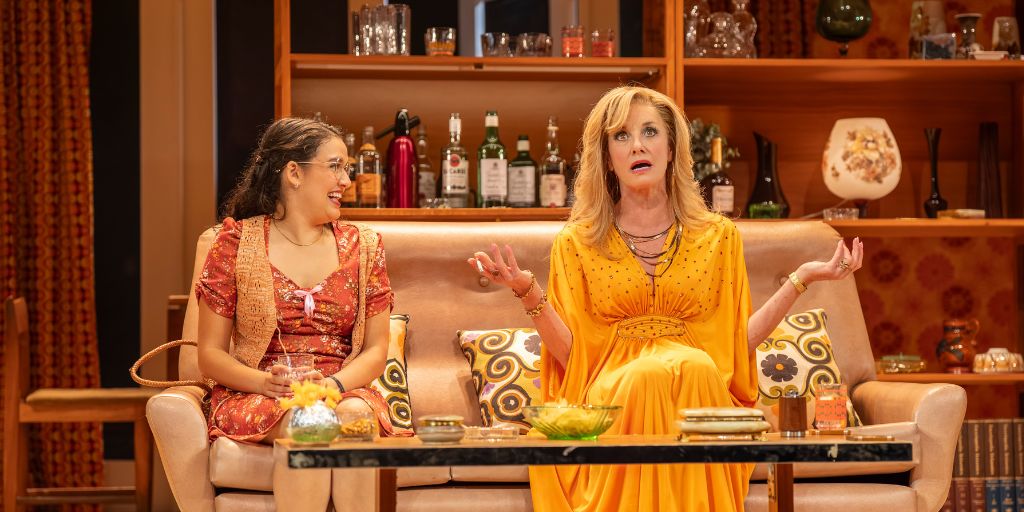
‘Abigail’s Party’ promises many a theatre-goer a night of pure nostalgia, a journey down Memory Lane, and all those other clichés which sum up this positively delicious play, an unforgettable zeitgeist of the ‘70s. If you lived through that decade there is no doubt that you’ll be transported to a world of some of the suburban social ladder-climbing aspirations of early married life, where proudly displaying a Europa furniture ‘unit’ with drop down drinks cabinet plus an upmarket 3 piece suite were high on the agenda. In these claustrophobic times, smoking extra length Dunhill cigarettes and drinking copious amounts of G&Ts were ‘de rigueur’. An absolute necessity was the cigarette box and table lighter proudly on show on the coffee table. Inviting friends round to be bathed in your reflective glory served as an endorsement of your rise from upper working to somewhere in the middle class. Throw in the cheese and pineapple on sticks, small bowls of salted peanuts and crisps and you have an almost perfect encapsulation of a 1970s soirée.
Written and directed by the brilliant Mike Leigh, the play was first performed in the spring of 1977 – incidentally just 6 months after the hottest 6 weeks in the UK on record, hotter and of a longer duration than we’re currently experiencing. It was subsequently shown on TV for ‘Play for Today’ on BBC1 in March 1977, starring the glorious Alison Steadman as Beverly and Tim Stern as Laurence. Whilst Alison sported the bobbed ‘Purdy’ haircut of the period, Tamzin went for the ‘Farah Fawcett’ look: an amazing long blonde mane made famous in ‘Charlie’s Angels’ the must-watch TV series of the time. It fitted perfectly with her provocatively sexy persona. Contrary to the views of many who came later to the play, ’Abigail’s Party’ is not purely a comic piece, in fact it is, although there are many outrageously funny moments, a dark, character driven play which builds up to a final, pretty shocking outcome.
I am delighted that after 49 years ‘Abigail’s Party’ is experiencing a renaissance, having had several revivals in the last year, with few structural changes or attempts to adapt it from its firm roots in the ‘70s. 1977 was the pre-Thatcher year of the 3 day working week, ABBA winning Eurovision in Brighton and Elvis’s death. A world without screens, AI, SatNav or more than a couple of TV stations. At times, even electricity was restricted and those TV stations had to cease broadcasting at 10.30pm – no streaming back then. So dinner parties and drinks with friends and neighbours became a bit of a thing in the long evenings.
This newest version of the play does not, thankfully, digress too much from the original, difficult anyway given the time of its setting. As Beverly, her overbearing, suffocatingly condescending veneer of superiority is perfectly recreated by the wonderful Tamzin Outhwaite, ably taking on the role with panache, clearly relishing every second. A hard act for the whole cast to follow from the original nearly half a century ago, but they all managed it with supreme success. To say that their interpretations were almost indistinguishable from the originals is no criticism, there was no hint of imitation, simply honouring what went before.
Beverly and Laurence (Kevin Bishop) are the pretentious hosts to their neighbours. Beverly is, bluntly, bursting with sexual frustration, and Tamzin delivers some magnificent moments when she is practically simulating sex to her monosyllabic taciturn neighbour Tony (‘Tone’), whilst her husband Laurence is equally pretentious in an entirely different fashion, whose own frustrations are largely how to stand up to his wife when she continually patronises him in front of others. He preens around the room pretending to have a Very Important Job (he’s an estate agent) boasting of his Shakespeare book collection, which he openly declares as ‘unreadable’, all displayed on the Europa unit, and his love of classical music. Beverly on the other hand is a lightweight snob, favours pop music, with a love of Demis Roussos (the popular Greek crooner of the time), denigrates fine art, and is a fan of the tasteless erotic kind. (Of course!). Both emit superiority by the bucketload, although Beverly’s tastes are pretty genuine, Laurence’s are merely top dressing.
Beverly and Laurence are already squabbling before their guests even arrive, she intent on goading her husband at every turn in her grotesquely imperious way. Laurence, although not completely emasculated, somehow fails to deliver any of the verbal blows his wife clearly deserves. Enter Tony (nicely understated performance from Omar Malik) and his little mouse of a wife Angela (‘Ange’), perfectly played by Lauren Patel with her simple mindedness and insipid admiration for their hosts’ domestic possessions. You need to blink twice to believe you are not seeing and hearing the Ange of 1977 (Janine Duvitski, who cornered the market is this type of woman). Last but not least this eclectic bunch are joined by Abigail’s emotionally constipated mother, who very obviously is middle class, making no effort to ‘dress up’, frumpily sporting flat brogues, tweedy skirt and some sort of jerkin. Beverly, by contrast, wears an outlandishly loud, low cut orange gauzy dress with blue platformed shoes. (Oh the pain!).
The eponymous Abigail does not make an appearance; she is 15 and having her first party at her house, so Susan (‘Sue’), is slightly anxious, and clearly deeply embarrassed by the behaviour of both hosts and guests. Portrayed beautifully by Pandora Colin, Sue is divorced but financially supported by her ex-husband, an architect. She is an unhappy woman and uncomfortable in a social setting, saying little but remaining calm and polite in the face of this hellish evening, but her facial expressions say so much more.
Beverly floats around, forever insisting on ‘top ups’ to the G&Ts, and foisting cigarettes on all, at the same time flirting flagrantly with the impervious Tone. Inevitably, with the gallons of gin imbibed by all (even though Sue declines Beverly just refills her glass regardless) the evening descends into nothing short of the most horrible chaos and in the second act, the horror proceeds at breathtaking speed. Sue is physically prevented from leaving by Beverly, even though her host has been constantly delivering snide remarks about the dreadful things teenagers get up to in these circumstances. In fact, this is the nub of Beverly’s character, she is basically a nasty ignorant closet bully, disguising it all with her brand of shallow hospitality, and dishing out ‘I know better than you’ advice on some highly personal issues – all done in an awful saccharine manner which makes you squirm with distaste.
I loved how, the more gin they knocked back, the characters’ true feelings and thoughts were aired. Ange in particular morphed gradually from a fairly introvert downtrodden woman to an embarrassingly outspoken wife, demonstrating her previously hidden deep dissatisfaction with her husband. As expected, the play culminates in this excruciatingly painful evening resulting in something awful. And then it ends – quite flawlessly. However, in between the bleakness and darkness, the play has some hilarious moments. I loved the unexpected intro with Tamzin Outhwaite dancing in a totally OTT fashion on the coffee table, prior to her husband and guests arriving. Donna Summer’s disco classic ‘Love to Love You Baby’ was the perfect choice of music! The second act’s opening to a strobe-lit tableau of the cast making jerky repetitive movements, all created in Beverly’s mind, was inspired. It was only the closing moments that I felt slightly uneasy about, it didn’t quite deliver the effect I was hoping for.
Lastly, I must congratulate Set Designer Peter McKintosh’s absolutely believable set, and the costumes, all very firmly of the era. Nothing seemed contrived or overdone. This is a faithful reproduction of the original, the entire cast was clearly having a wonderful time, with the standout performances coming from the women. Tamzin Outhwaite was in her element. As was I.
⭐⭐⭐⭐
Reviewer: Gill Ranson
Photo: Ellie Kurtz
Tickets for this production were gifted in return for an honest review.